Quality Assurance in AI-Assisted Development: Essential Practices for Team Environments
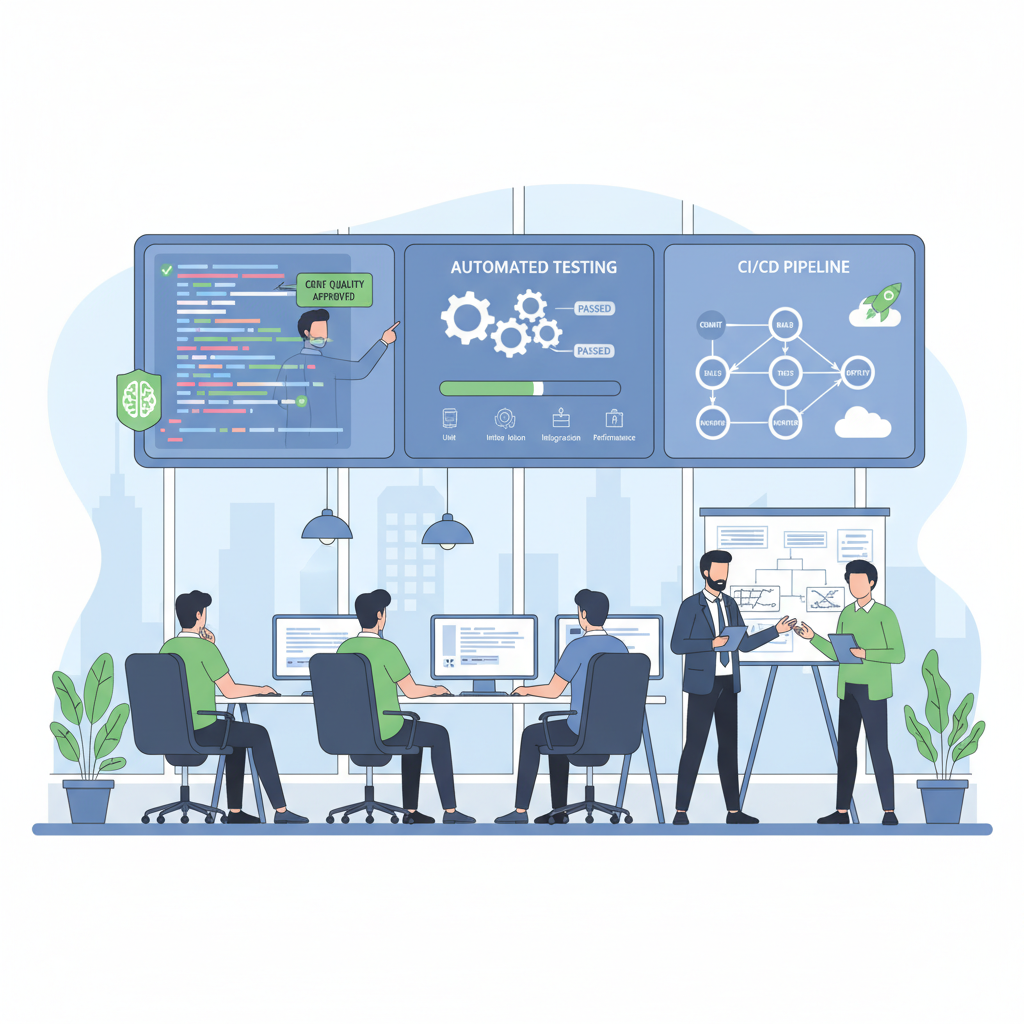
The AI Development Revolution in Team Settings
Working in a team of four developers, all leveraging AI tools for development, has been an eye-opening experience. I’ve explored countless new approaches and discovered that while AI dramatically accelerates coding, maintaining code quality becomes even more critical. Today, I want to share my key learnings about creating an AI-friendly development environment focused on automated maintenance and quality assurance.
Testing: The Foundation of AI-Assisted Development
Contrary to what some might think, testing becomes even more important when working with AI. Unit tests and integration tests aren’t just nice-to-have—they’re essential guardrails that prevent AI from generating unexpected code.
Test-Driven Development with AI
TDD takes on new significance in AI workflows. I found that human-designed tests, written from a customer perspective (following BDD and ATDD principles), serve as crucial boundaries for AI code generation. Without these constraints, AI can easily produce code that meets technical requirements but misses business logic expectations.
Tests act as a “guard line” that ensures AI output aligns with our intended functionality. This approach transforms AI from a potentially unpredictable tool into a reliable coding assistant.
Pre-commit and Pre-push Hooks
I implemented automated testing in our Git workflow to catch issues early:
- Pre-commit hooks ensure no failing tests make it into commits
- Pre-push hooks provide an additional safety net before code reaches shared branches
While not guaranteeing bug-free code, these hooks ensure test failures are caught immediately, preventing broken code from propagating through the team.
Linting and Formatting: Consistency at Scale
AI tools often introduce inconsistencies, especially in TypeScript where I frequently see overuse of the any type. Linting and formatting have become non-negotiable in my workflow.
The Power of Automated Code Quality
Linting catches common issues that AI might overlook, while consistent formatting maintains code readability across the team. These checks are relatively fast and provide significant quality improvements with minimal overhead.
I discovered that small, consistent changes in formatting and style guidelines dramatically improve overall code quality and team collaboration.
AI-Powered Code Review: Accuracy Over Speed
I experimented with Codex for code reviews and found an interesting trade-off. While slower than other AI tools, Codex provides remarkably accurate, laser-focused feedback that I trust implicitly.
The precision of Codex reviews often uncovers issues that faster tools might miss, making it valuable despite the performance cost. This experience taught me that different AI tools serve different purposes in the development pipeline.
Optimizing Test Execution
One challenge with AI-generated tests is test suite bloat. AI makes it easy to create comprehensive test coverage, but running thousands of tests before each commit creates significant bottlenecks—I’ve seen wait times exceeding five minutes.
Smart Test Filtering
My solution: focus testing on changes between the current branch and base branch. By identifying and running only tests affected by recent modifications, I reduced test execution time dramatically while maintaining quality assurance.
This approach ensures I don’t waste time re-running unaffected tests, while still catching regressions in my changes.
CI/CD Pipelines: The Quality Gatekeeper
The most critical component of my AI-friendly development environment is a robust CI pipeline. Every merge to main or develop branches triggers:
- Full test suite execution
- Linting and formatting checks
- Build verification
This creates an unbreakable quality gate that prevents problematic code from entering production, regardless of how it bypassed local checks.
The AI Bypass Problem
I discovered that AI tools can sometimes “force” their way past local quality checks, either by generating code that technically passes tests or by manipulating linting rules. The CI pipeline serves as my final, unbypassable line of defense.
Even when AI-assisted development moves quickly, the CI pipeline ensures that only thoroughly validated code reaches production.
Lessons Learned
My journey with AI-assisted development has reinforced that automation and quality practices aren’t diminished by AI—they’re amplified. The speed AI provides makes comprehensive quality assurance not just important, but absolutely essential.
Key takeaways:
- Design tests first to guide AI code generation
- Implement multiple quality checkpoints (local hooks + CI)
- Use AI tools strategically for different purposes
- Optimize workflows to maintain speed without sacrificing quality
- Treat CI pipelines as non-negotiable quality gates
As AI continues to evolve, these practices will become even more crucial for maintaining reliable, high-quality software in team environments.
#Ai #Testing #Tdd #Development #Ci-Cd #Code-Quality #Team-Workflow