Git Worktrees: Parallel Development in the AI Age
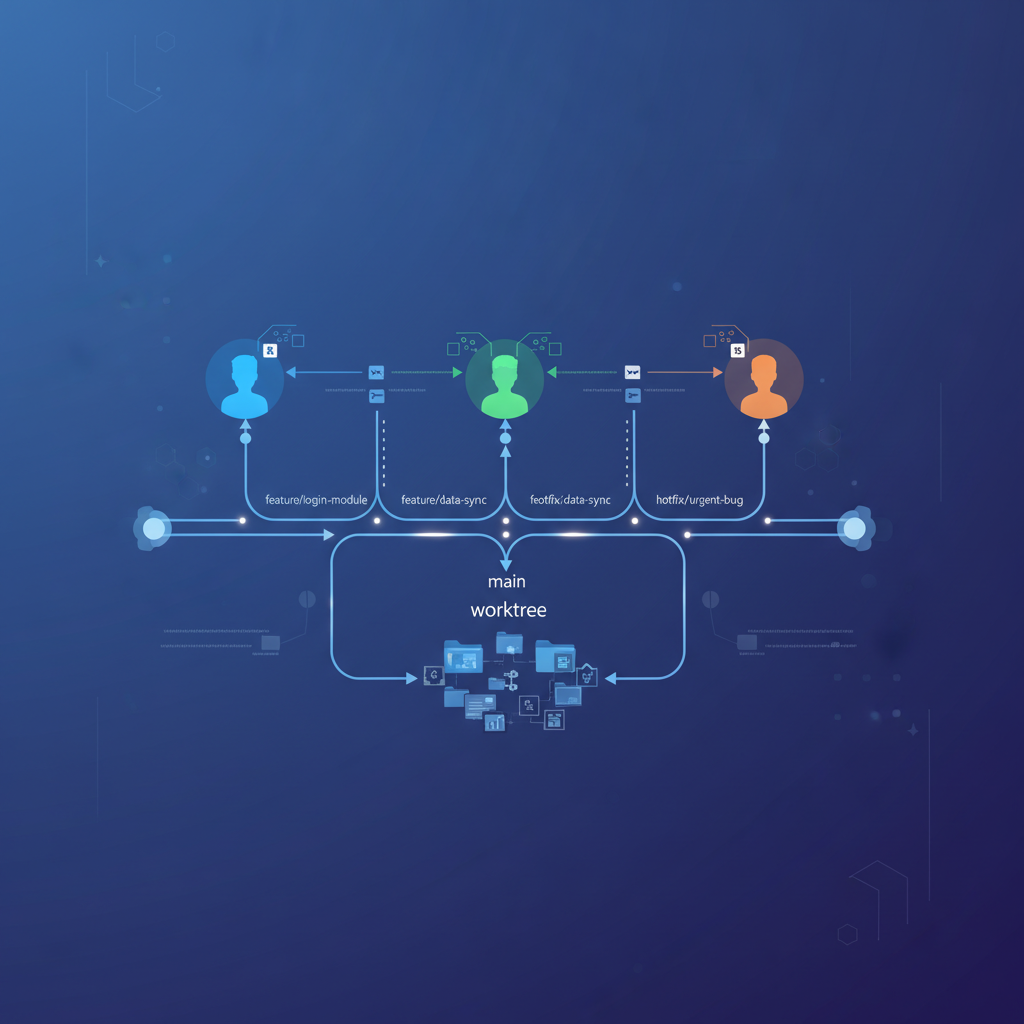
Rediscovering Git Worktrees for AI-Assisted Development
Today I’ve been thinking about how traditional version control systems like Git are evolving in the AI age. While Git has been fundamental for managing code history and collaboration, I’ve discovered that one feature—git worktree—has become particularly powerful in AI-assisted development workflows.
The Traditional Branching Problem
In conventional development, when you need to work on different features or approaches, you typically create separate branches. For small projects, this works fine. But for large codebases, switching between branches can be slow and resource-intensive. Every checkout operation might trigger rebuilds, dependency installations, or IDE reindexing.
This branching model encourages sequential thinking—you work on one approach, test it, then either iterate or abandon it for another strategy.
Git Worktrees: Multiple Working Directories
Git worktrees solve this by allowing you to have multiple working directories linked to the same repository, each checked out to a different branch or commit. This means you can:
- Have multiple branches active simultaneously
- Switch between contexts without the overhead of checkout operations
- Work on parallel approaches without context switching costs
The AI Development Paradigm Shift
This is where git worktrees become revolutionary in AI-assisted development. When working with AI, you’re no longer limited to sequential exploration of solutions. Instead, you can:
Parallel Strategy Exploration
For a single feature, you can generate multiple implementation strategies using AI:
- Worktree 1: Object-oriented approach
- Worktree 2: Functional programming approach
- Worktree 3: Algorithmic optimization approach
- Worktree 4: Design pattern implementation
- Worktree 5: Experimental cutting-edge solution
Isolated Development Environments
Each worktree maintains its own working directory while sharing the same Git history. This means:
- No conflicts between different approaches during development
- Independent testing and validation of each strategy
- Clean comparison without merge conflicts during exploration
Quality Over Iteration
Instead of asking an AI to iterate repeatedly on a single solution (potentially getting stuck in local optima), you can:
- Generate multiple distinct approaches simultaneously
- Evaluate each independently
- Select the best solution based on objective criteria
- Merge only the winning strategy back to main
Practical Workflow Example
Here’s how this might work in practice:
1# Create main worktree for your feature branch
2git worktree add ../feature-strategy-1 feature-branch
3
4# Create additional worktrees for different approaches
5git worktree add ../feature-strategy-2 feature-branch
6git worktree add ../feature-strategy-3 feature-branch
7
8# Now work in parallel across three directories
9# Each can have different AI-generated implementations
In each worktree, you can have AI generate completely different solutions, test them independently, and compare results objectively.
The Benefits for AI Development
- Increased Exploration: More approaches can be evaluated in the same timeframe
- Reduced Bias: Less attachment to any single solution during development
- Better Quality: Objective comparison leads to selecting superior solutions
- Faster Iteration: No context switching overhead between approaches
- Risk Mitigation: Multiple backup strategies if the preferred approach fails
Beyond Single Features
This approach scales beyond individual features. You can have:
- Multiple worktrees for different components of a system
- Parallel development of independent features
- Experimental branches that don’t affect main development
- A/B testing of different architectures
The Future of Collaborative Development
In team environments, this becomes even more powerful. Different team members can work on parallel approaches in their own worktrees, then converge on the best solutions. AI can assist in generating and evaluating these approaches, while human developers provide strategic direction and final decision-making.
Conclusion
Git worktrees represent a fundamental shift in how we think about version control in the AI age. They enable the kind of parallel exploration that AI development workflows naturally support, moving us from sequential iteration to parallel strategy evaluation.
This isn’t just about productivity—it’s about quality. By exploring multiple approaches simultaneously and selecting the best objectively, we increase our chances of finding optimal solutions rather than settling for “good enough” iterations.
The combination of AI’s generative capabilities and git worktrees’ parallel development environment creates a powerful synergy that’s transforming how we approach software development. It’s a reminder that sometimes the most valuable tools are the ones we already have, waiting to be rediscovered in new contexts.
Note: This exploration comes from thinking about how traditional development tools can enhance AI-assisted workflows. The parallel strategy approach has been particularly valuable in recent projects where multiple implementation paths needed evaluation.
#Git #Ai #Development-Workflow #Version-Control #Productivity