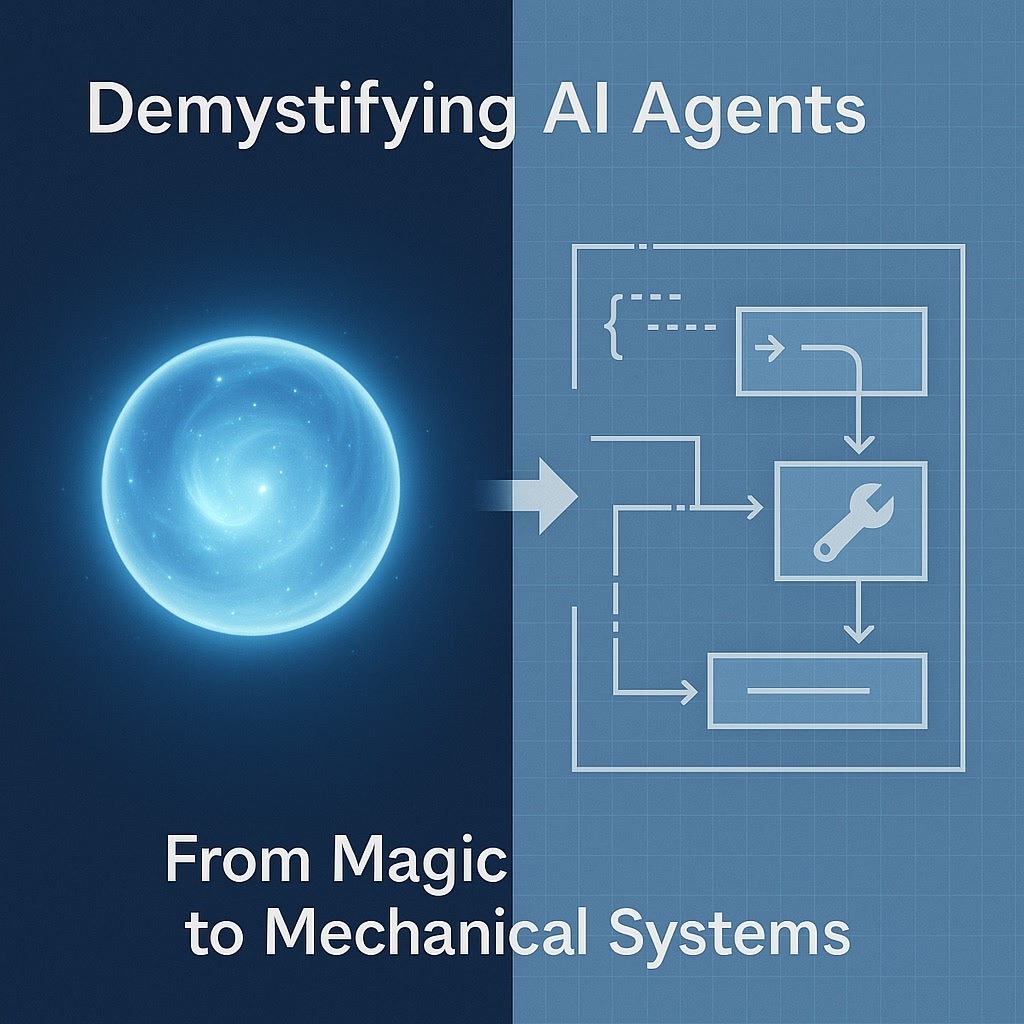
Demystifying AI Agents: From Magic to Mechanical Systems
The Revelation That Changed Everything
Today I want to talk about something that’s been on my mind all day: AI agents. This concept was completely new to me not long ago, and I’ve been using various AI tools like ChatGPT, Gemini, and Claude in their classic chatbot interfaces. For the longest time, my understanding of AI was limited to these conversational interfaces—essentially a queue-based system where you ask questions and get responses.
But agents? Agents were something different. Before diving deep, I couldn’t even grasp how they worked conceptually. I knew that agents were basically chatbots with the ability to use tools, but how was that even possible? From a data perspective, the AI is just processing JSON—a chunk of structured text. How could that possibly invoke external tools and perform actual work?
The Mental Block: From String to Action
Here’s what confused me: AI models are fundamentally text processors. They take in strings (prompt text) and output strings (responses). How could a string-based system trigger real-world actions? It seemed like magic.
But after a day of research and actually building my own coding agent, I discovered that the agent concept is not just new—it’s surprisingly straightforward. The “magic” I was seeing wasn’t magic at all, but rather a clever extension of the chatbot pattern I already understood.
The Chatbot-Agent Continuum
Think about how a traditional chatbot handles complex tasks. Imagine you ask ChatGPT to create a tourist plan. The chatbot might respond: “I can help with that, but I need some information. Could you provide today’s weather conditions and any specific attractions you’re interested in?”
What happens next? You, as the human user, open a weather website, check the conditions, copy-paste the information back to ChatGPT, and it continues with the plan.
This is the classic loop: AI requests information → Human provides information → AI uses the new context to continue.
The Agent Breakthrough: Replacing the Human
Here’s the fundamental insight: Agents follow the exact same pattern, but replace the human intermediary with function calls.
Instead of the AI asking you for weather information and waiting for you to manually provide it, the agent invokes a get_weather tool. The process looks like this:
- Traditional Chatbot: AI asks human → Human researches → Human provides response → AI continues
- AI Agent: AI triggers tool → Tool executes automatically → Tool returns response → AI continues
The context is still provided to the AI, but now it comes from an automated function rather than a manual human input.
How It Actually Works: The Streaming Trigger Pattern
The technical implementation is elegant in its simplicity. Here’s what happens under the hood:
The Streaming Detection
When the AI generates its response, it streams text tokens in real-time. The system monitors this stream for specific patterns—special trigger formats that indicate the AI wants to use a tool.
The Interrupt and Execute
When the system detects a trigger (like get_weather(location="New York")), it:
- Stops the streaming of AI response
- Parses the function call to understand what tool to invoke
- Executes the function with the provided parameters
- Waits for the result from the tool execution
The Context Injection
Once the tool returns its result (like a weather report), the system:
- Injects the result into the conversation context
- Resumes the AI generation with the new information
- Continues the conversation as if the AI had always known the weather
From the AI’s perspective, it doesn’t matter whether the context came from a human manually typing it or from a tool automatically providing it. It’s just text in its context window.
The Role of the Developer: The Orchestrator
As developers building these agents, our job is to:
- Define the tool interfaces: What functions can the AI call and what parameters do they accept?
- Implement the tool logic: Actually make the API calls, database queries, or computations
- Handle the orchestration: Detect triggers, manage execution, and inject results
- Provide clear prompts: Teach the AI what tools are available and when to use them
The “Aha!” Moment
My breakthrough realization was understanding that agents aren’t fundamentally different from chatbots—they’re chatbots with automated context providers. Instead of relying on humans to manually gather and provide information, we automate that process through function calls.
The AI doesn’t need to understand how the weather API works. It doesn’t need to know about HTTP requests or API keys. It just needs to know:
- “If I need weather information, I can use the
get_weathertool” - “The tool requires a location parameter”
- “When I call it, I’ll get weather data back that I can use in my response”
From Mystery to Pattern Recognition
After implementing my own agent solution, what seemed like magical AI capabilities transformed into recognizable patterns. An agent is essentially:
- A standard LLM chatbot
- Plus a streaming monitor for tool triggers
- Plus a function execution system
- Plus context injection mechanisms
That’s it. No deep magic, no complex AI architecture changes—just clever engineering around the existing chatbot paradigm.
Why This Matters
Understanding this demystifies agents in several important ways:
1. Predictable Behavior
Agents behave predictably because they follow the same reasoning patterns as chatbots. If a chatbot struggles with certain types of reasoning, an agent will likely have the same struggles—the difference is just in how they gather information.
2. Debuggable Systems
When agents fail, we can debug them like any other software system. Is the trigger detection working? Is the function executing correctly? Is the result being properly formatted?
3. Accessible Development
You don’t need specialized AI knowledge to build agents. You need standard programming skills to implement the tool functions and orchestration logic.
4. Incremental Enhancement
You can start simple with basic tools and gradually add more sophisticated capabilities. The core pattern remains the same.
The Human Parallel
Interestingly, this mirrors how humans work with tools. When I need to check the weather, I don’t magically know the temperature—I use a weather app. When I need to calculate something complex, I use a calculator.
AI agents do the same thing, but instead of physically opening apps or websites, they invoke functions programmatically. The AI remains the “thinking” entity, while the tools handle the specialized tasks.
Looking Forward: What This Enables
Now that we understand that agents are essentially chatbots with automated tool access, we can see the exciting possibilities:
Multi-Tool Collaboration
Agents can chain multiple tools together, using the output of one tool as input for another—just like humans do.
Real-time Data Integration
Agents can work with live data sources, providing up-to-the-minute information without manual intervention.
Complex Task Automation
By combining multiple tools with sophisticated reasoning, agents can handle complex multi-step workflows.
Customized Workflows
We can build specialized agents for specific domains by providing them with domain-specific tools.
The Simplicity That Enables Complexity
The beauty of the agent architecture is that the core concept is simple enough to grasp and implement, yet powerful enough to enable incredibly complex behaviors. By understanding that agents are just chatbots with automated context providers, we can:
- Build them confidently knowing we understand the fundamentals
- Debug them effectively because we know where things can go wrong
- Extend them creatively because we understand the pattern
- Integrate them seamlessly into existing workflows
Conclusion: From Magic to Engineering
What seemed like mysterious AI magic has revealed itself to be elegant engineering. Agents aren’t a fundamental breakthrough in AI reasoning—they’re a breakthrough in AI integration.
The “magic” of agents watching streaming text, detecting tool calls, executing functions, and injecting results is just sophisticated software engineering around the existing LLM chatbot pattern.
And that’s precisely why it’s so exciting. Because now, instead of seeing agents as some impenetrable AI concept, I see them as a development pattern I can understand, implement, and extend.
The agents are no longer magic. They’re just chatbots with better tooling. And in the world of software development, better tooling is something we understand very well indeed.
Note: This exploration comes from hands-on experience building and understanding AI agent systems. The implementation details reflect real-world development patterns and the mental journey from confusion to clarity.